Over The Summer… {sensory play}

over the summer button

Since I work in the public school system, I enjoy a brief summer break.  I don’t mean to complain, but summer breaks are not June-July-August like the good ol’ days; they are now a mere couple of weeks.  Just like with everything, all good things must eventually come to an end, and my summer break is officially over.  Sniff, sniff!

As a bit of a department tradition, on the first day of “school” we swap stories of our summer break, which usually consist of travel across country or abroad.  It’s always reminiscent of grade school days where the teacher assigns the infamous essay, “Over the summer…” and you recant the events of summer.  While a few of my colleagues were brave enough to travel with toddlers in tow, George and I knew that taking four babies on a road trip would be nothing but drama.  However, that doesn’t mean we sat home on our duffs all summer.  We had plenty of adventures right from home and around town.  Stay tuned for our mini-series of sharing what we did over the summer.

While at home, I tried to expose the babies to a variety of sensory play opportunities.  Some were a huge success, others a flop.  Nonetheless, they are all worth remembering, even if they include what NOT to do.

One day I was solo with the babies and they were not particularly content staying indoors at home.  I had really been wanting to do water play with them, but knew that taking them outside myself was not a stellar idea.  Instead, I set up shop in our master bathroom.  I filled a shallow tub with water and brought in new toys purchased for the babies’ birthday party.  To prevent the bathroom from transforming into a Slip ‘n’ Slide, I set an old quilt underneath the tub.  Since the babies aren’t generally permitted in our bathroom, they had a fantastic time splashing and making note of their new surroundings.

Part of the fun was the water, the other was being in a foreign room of the house.

Part of the fun was the water, the other was being in an otherwise forbidden room of the house.
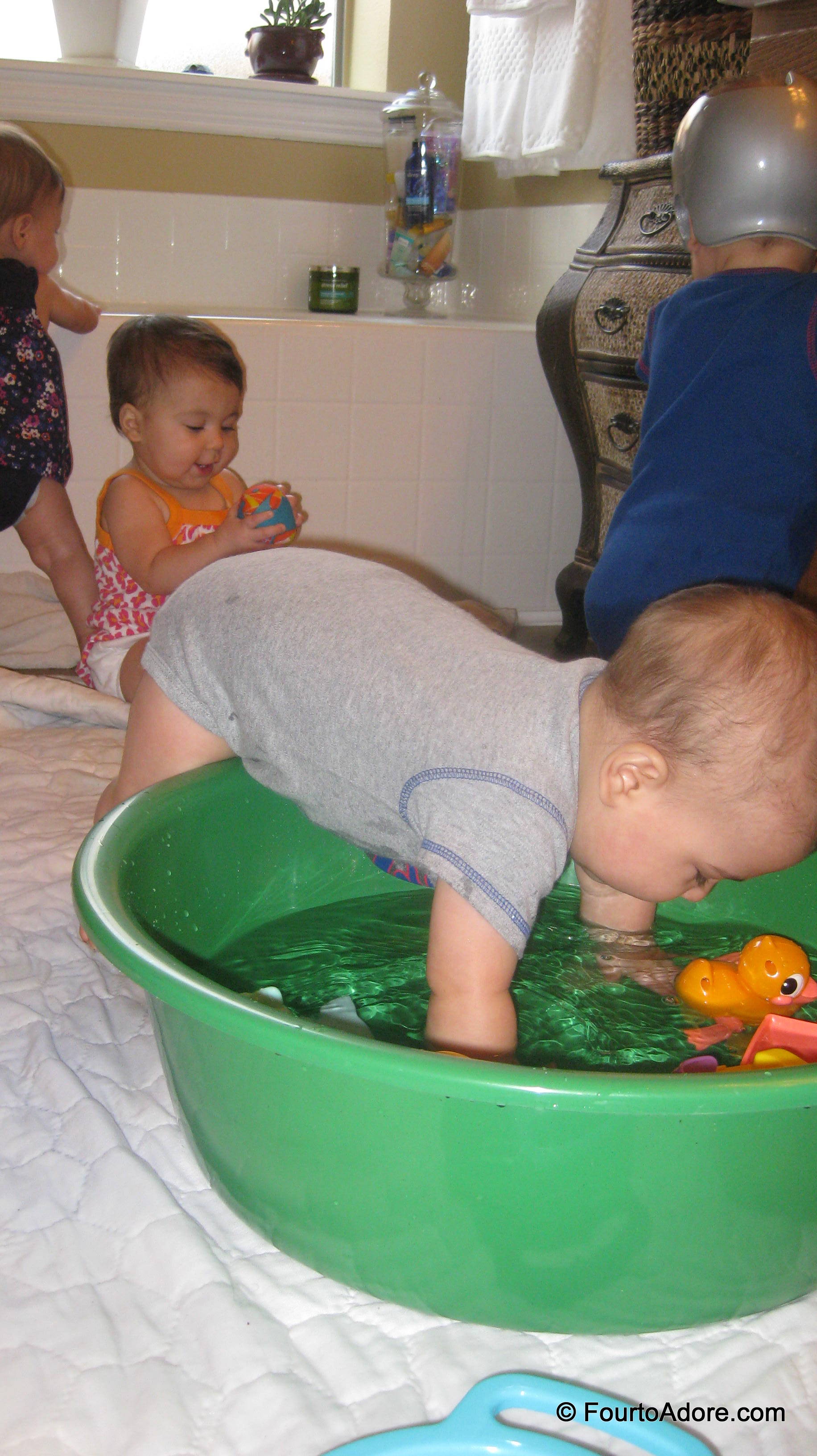
Harper was the only baby who wanted IN the water tub.

Harper was the only baby who wanted IN the water tub.

Perhaps my favorite sensory activity of all was Cool Whip smearing.  I dressed the babies in swim suits and sat them at the quad table where I slapped a dollop of Cool Whip and a few drops of food coloring in front of each baby.  It didn’t take them long to figure out this was great fun and delicious too.  Sydney was hesitant to experiment since she’s not keen on getting messy, but she too joined in on the action.  Since I had a helper with me that day, we transferred the babies outdoors for a dip in the baby pool following this royal mess.

Mason enjoyed leaning forward to dab his nose in the Cool Whip.

Mason enjoyed leaning forward to dab his nose in the Cool Whip.

I thought it was interesting how each of the babies had a different pattern in their Cool Whip swash.

I thought it was interesting how each of the babies had a different pattern in their Cool Whip swash.  Some made vertical motions while others moved horizontally or even both directions.

Of course, half the fun of Cool Whip play is eating it!

Of course, half the fun of Cool Whip play is eating it!

Sydney was hesitant to get her hands dirty, but eventually patted the creamy stuff.

Sydney eventually patted the creamy stuff.

While this activity wasn’t as exciting for the babies, I loved the mess-free play!  I stumbled across this idea somewhere on Pinterest.  I slipped a piece of card stock into gallon bags and squirted Tempera paint in the bag, and taped them to the quad table.  For added dimension, I tossed a few sequins and a bit of glitter in the bags.  It entertained the babies for quite a while as they slapped, squished and patted the bags.  I don’t recommend using Duct tape, however.  George was not pleased to find it took bits of the finish off the table.
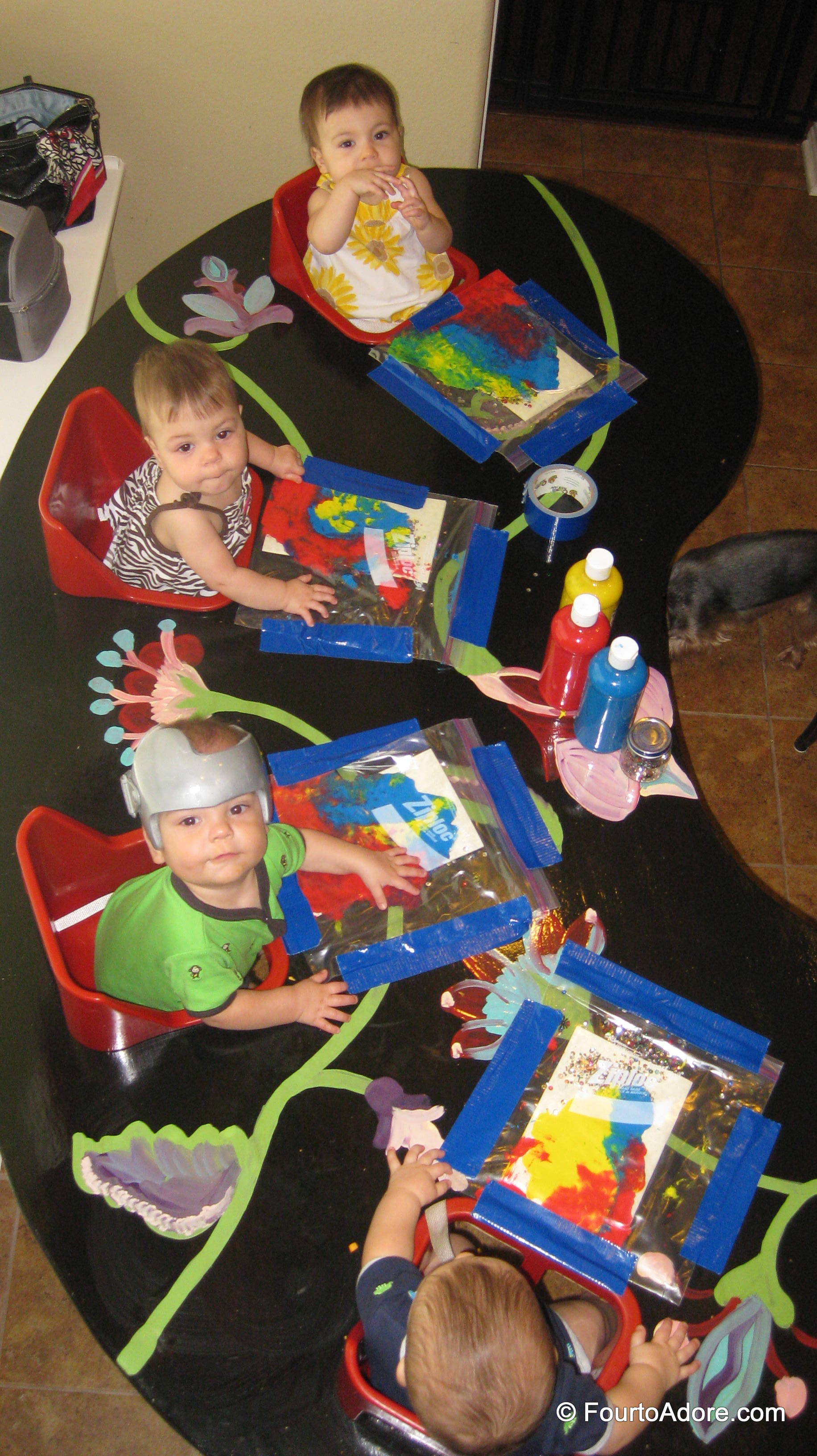
Each baby approached their work in a unique way.

Harper didn’t much enjoy this one, but at least he didn’t complain.

Rylin really loved smearing and patting.

Rylin really loved smearing and patting.

For the babies’ party, I reused our water play tub as a make shift sand box.  At the party, but it wasn’t a popular station.  If given a choice, kids apparently prefer water over sand.  However, I wasn’t letting a good bag of play sand go to waste so each of our babies got a turn experiencing the “beach”.
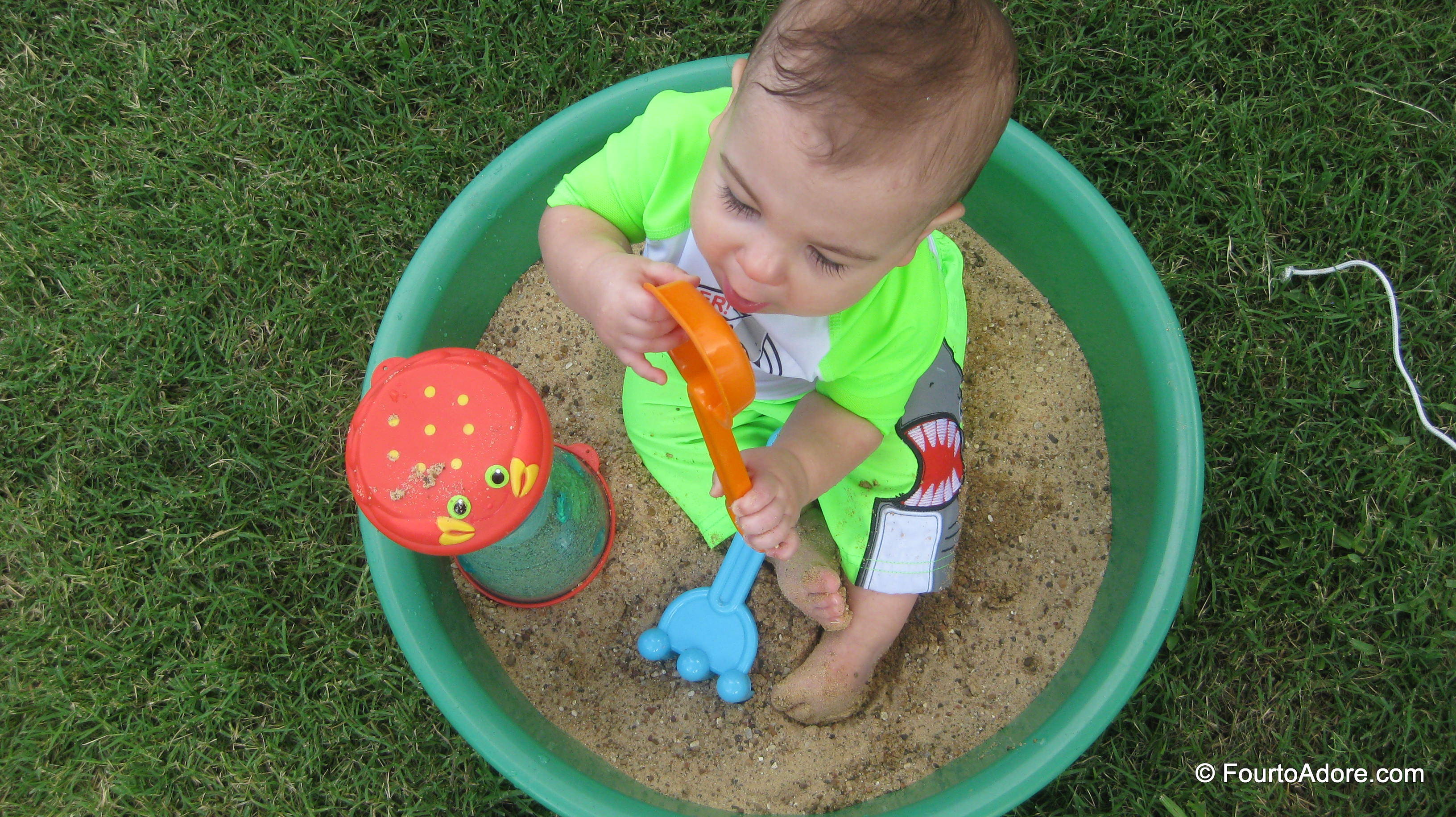
Harper may have taken a teeny taste of sand...

Harper may have taken a teeny taste of sand…

Needless to say, some babies enjoyed the sand more than others...

Needless to say, some babies enjoyed the sand more than others…

One night George and I had an abundance of left over angel hair pasta noodles so it became time for yet another sensory play activity.
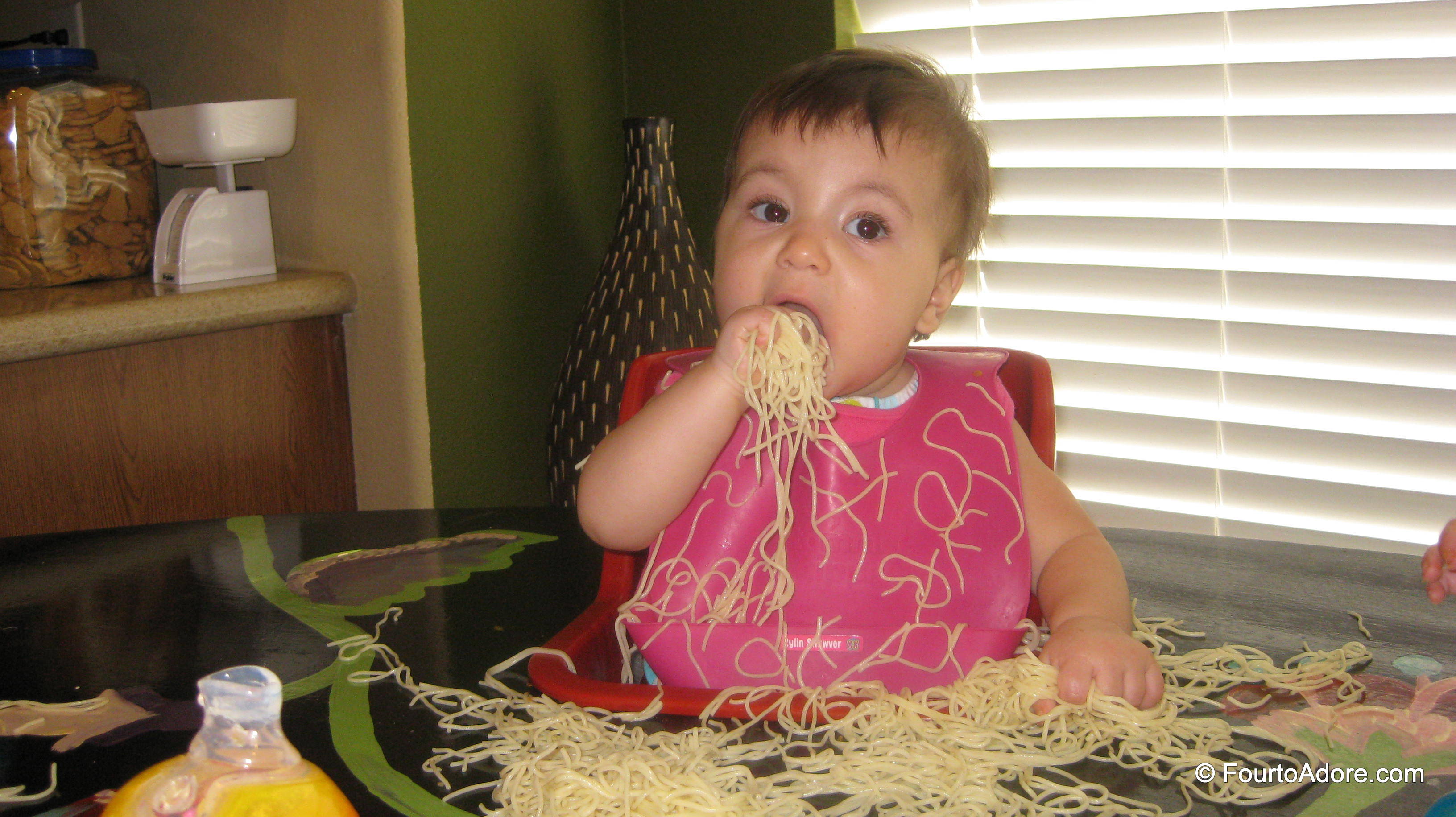
Rylin tackled spaghetti with reckless abandon!
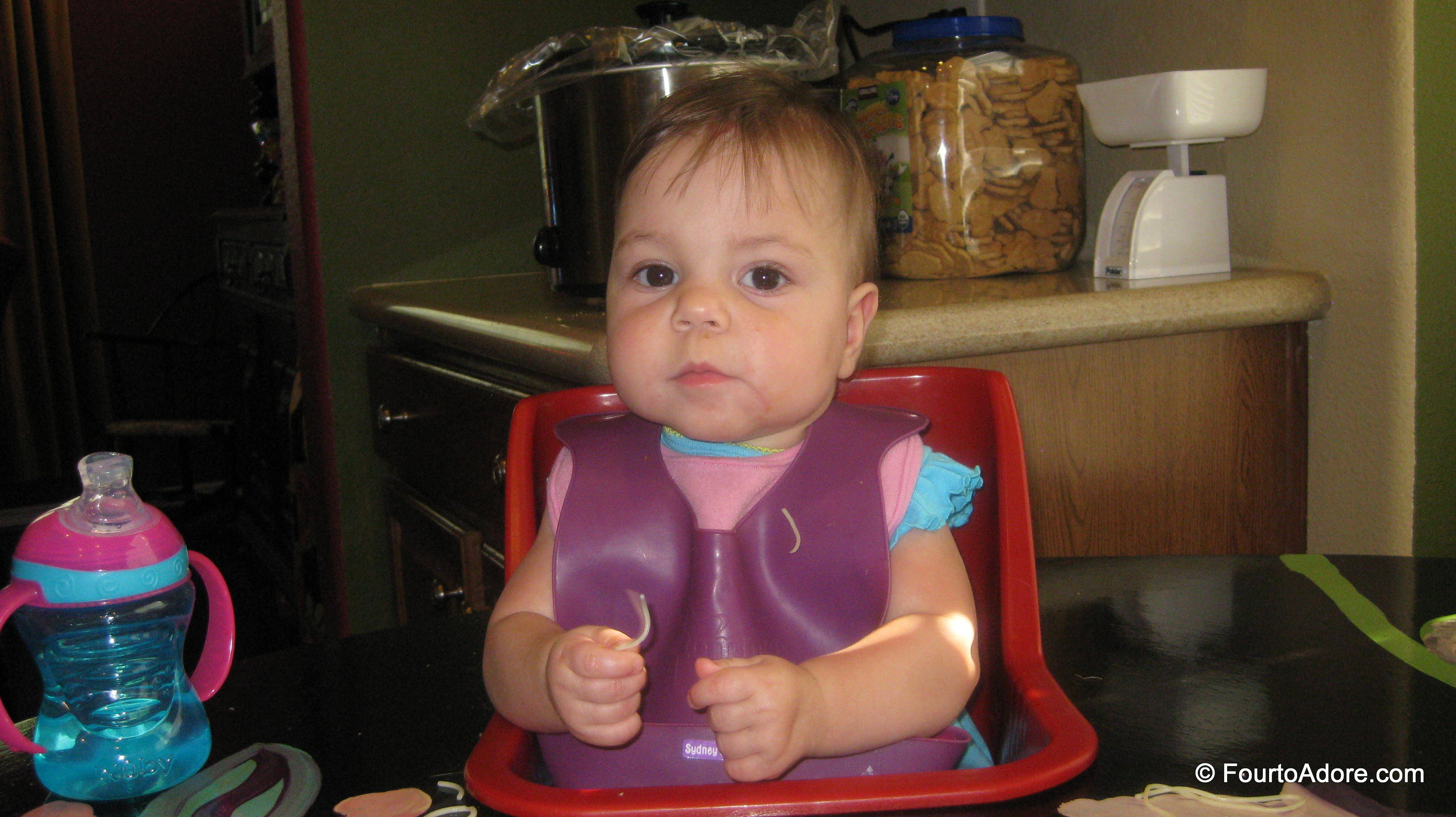
Rylin tackled spaghetti with reckless abandon!

Sydney delicately touched just one strand of spaghetti at time.

Sydney delicately touched just one strand of spaghetti at a time.

This final activity was perhaps not my brightest moment.  I searched for paint with water books (you know, the ones that look similar to coloring books with paint around the edges that brighten with a wet brush?).  Instead, I found coloring books with water paint strips attached to the top.  I thought it could work.  Just like when I worked in preschool, I taped the paper to the table and used a large sponge brush dipped in water.  First, I demonstrated dragging the damp brush across the top and over the paper, but the babies didn’t agree with this method.  This is when our previous edible sensory play activities interfered.  Instead of following my lead, the babies tore bits of paper off the table and proceeded to sample them.  When Rylin attempted to eat more than the paper, she did not appreciate being reprimanded.  There’s probably a good reason the recommended age for paint with water is three and up.  I think we’ll save this for a few more years.  In the meantime, maybe we’ll try that edible finger paint recipe I pinned.

Look closely at the tip of Rylin's paint brush.  Do you notice anything?

Look closely at the tip of Rylin’s paint brush. Do you notice anything?

Stay tuned for more in this series: DIY projects, parents getaway, and Friday field trips.  How did you spend your summer?

hugs!

Amber

PS- If you can’t get enough of Four to Adore, don’t forget to follow us on Facebook, Twitter, and Pinterest!

Semi-Homemade Baby Food

DIY baby food using frozen produce, BPA free canned goods, diary, and pantry items.

By age six months, our pediatrician wanted us to begin spoon feeds with the babies. It doesn’t take a mathematician to figure out that using jarred food is not the most frugal way to feed four babies so we set out to make our own. When we first began making our own baby food we started solely with fresh produce bought in bulk: pears, bananas, avocados, and butternut squash. As the babies soared at noshing on these purees, we knew it was time to expand their palates. While we found making everything fun, it was also very time-consuming. George and I stepped back and considered our goals in feeding the babies solid foods. We determined it was to provide them with nutritional food and expose them to a variety of flavors and textures. Also when caring for four babies we are always budgeting two things: time and money. No doubt, homemade baby food offers a substantial savings over jarred baby food and is also more wholesome. However, making everything from scratch is not always the best way to budget our two precious commodities. Thus, I started getting creative in making “semi-homemade” baby food. When I go shopping to make baby food I divide what I will make into these categories: fresh produce, frozen produce, dairy, and canned foods/pantry items. When there is no price difference, I always choose organic. If there is a higher price, I only choose organic if it is an item with thin skin that is eaten (e.g. berries), but don’t put too much stalk into trying to buy all organic. The last few times I went shopping, I tracked some of the price per ounce to help compare to jarred baby foods. On average a jar of baby food costs $.16/oz. I’ve listed the average cost of items we buy regularly (for items where I kept data at least) for comparison.

How to make baby food using frozen, dairy, canned, and fresh produce

Fresh Produce

Without a doubt fresh produce generally offers the most nutritional value. When selecting items to puree I consider the price: what is in season and on sale? I also consider ease of preparation. I choose items that involve the fewest steps possible. For example, bananas are both the cheapest and simplest to prepare: peel and puree. That’s it. Whereas making pears requires: washing, peeling, steaming, then pureeing. That is a four step process! So if you are going for fresh produce think cheap & easy!

Make your own baby food by pureeing fresh produce bought in bulk, and freezing in ice cube trays.

My top picks for fresh produce are:

bananas $.04/oz

avocados $.08/oz

sweet potatoes (I bake them then pull the skins off and mash)

squash

baby carrots $.05/ oz

berries (any variety in season)

Frozen Produce

I found that frozen produce is an excellent way to supplement fresh items. Many times frozen produce contains the same (or greater) nutritional value as fresh because it is frozen at the peak of ripeness, and they offer items that may not be in season. I buy some of our frozen produce items in bulk from Costco, but I also buy small steam in bag varieties on sale at the grocery store. The smaller bags are perfect for the first time we sample something new. I toss them in the microwave for five minutes to steam then puree in the Baby Bullet. If the babies have an extreme aversion to them or an allergy then I don’t have to contend with an abundance of something. Also, I’ve found some steam in bag veggies that aren’t available in bulk. There are even some items such as fruits that do not require steaming at all. I let them thaw in the blender or Baby Bullet then puree them.

Steam frozen fruits and vegetables to puree for homemade baby food.

My top picks for frozen foods are:

berries (any variety) $.12-$.15/oz

peaches $.09/oz

broccoli $.06/oz

green beans $.06/oz

mixed vegetables

corn $.06/oz

peas $.06/oz

spinach $.06/oz

Dairy

Dairy items offer great sources of calcium and protein while taking a tart fruit or bitter vegetable down a notch. As far as yogurt goes, I price compare at the grocery store considering what is the least expensive per ounce. I stray away from “Light” versions due to the aspartame contained in them.

Consider using dairy products with fruit or veggie purees for baby food.

My go-to items from the dairy section are:

yogurt (I use both flavored and plain) $.07/oz.

ricotta cheese $.08/oz

cottage cheese $.07/oz

Canned Goods/ Pantry Items

Believe it or not, I find great baby food items in the canned food section. I check for the items with the fewest ingredients and additives and avoid anything that says “syrup”. Also, look for cans that are BPA free.  Canned beans offer excellent sources of protein and require no cooking while canned pure pumpkin is chock full of fiber and vitamins. The best part about using canned goods is they do not require cooking, refrigeration, or freezing and travel well. When we take the babies out, we often bring cans of pumpkin and cups of applesauce.

Canned foods can be pureed as baby food.

On my list of canned goods/ pantry items are:

beans (all varieties) $.06/oz

pure pumpkin (NOT pumpkin pie filling) $.06/oz

corn $.05/oz

asparagus $.10/oz

applesauce $.05/oz

chicken, beef or vegetable stock (I sometimes add these to veggie purees as a source of protein)

Applesauce is an easy option for baby food. It mixes well with most any vegetable to add sweetness without artificial sugar. Look for

I have a few favorite “recipes” for the babies and have also begun to puree the side dishes from our meals to make preparation much easier. As of right now, each “recipe” is one meal for all four babies, so it makes about four servings.

1. Creamy Corn

Steam 2 c. corn (or use one can corn rinsed and drained) then puree with 1/2 cup cottage cheese

2. Pumpkin Soufflé 

mix 1 can pure pumpkin (NOT pie filling) with 1 c. applesauce and add a dash of brown sugar and cinnamon

I also do the same “recipe” with 1/2 c.-1 c. pureed carrots

3. Fiesta Beans and Corn

rinse and drain 1 can of beans (any kind), puree with 1 c. steamed corn (or one can corn rinsed and drained)  and 1/2 c. plain yogurt

4. Pre–lasagne

steam a 12 oz bag of spinach and puree with a handful of grape tomatoes and 1/2 c. ricotta cheese

the babies also enjoy just spinach and ricotta cheese without the tomatoes

5. Refried Beans

drain and rinse 1 can of beans (any variety) then puree and blend in 1/4 c. plain yogurt

6. Fruity Oatmeal Smoothie (It occurred to me that minus the oatmeal I can also have this for breakfast if I double the recipe)

thaw 1 c. frozen berries then puree with 1/2 a banana, blend in 1 c. yogurt and 1 c. baby oatmeal

7. Green Bean Casserole

steam 1 -2 c. frozen green beans and puree with 1-2 baked potatoes (skin removed), use chicken or beef broth to get a smooth consistency

8. Sweet Peas

steam 1 c. frozen peas then puree with 1 c. applesauce

Disclaimer:  Follow the advice of your pediatrician regarding which foods to serve to your baby and when. Our pediatrician happens to be rather liberal and only has two rules for feeding babies after age 6 months 1. NO honey before age one 2. serve one ingredient at a time and wait 2-3 days before introducing a new one, monitoring for any signs of allergy. I used the following books as a guideline when preparing food for our babies:

What are some of your favorite baby food combinations or recipes? I’d love to hear what other culinary creations babies are being served.

hugs!

Amber